Serial Vs Parallel Data Transmission Pdf
Gigaware pc wired controller driver. I have a gigaware usb controller, that i'm trying to use on my laptop which has windows 8. I understand that the Gigaware USB controller is not working in your Windows 8 computer. You can contact the USB controller manufacturer and then try to download and install the latest driver for the device. The best way to fix your PC to run at peak performance is to update your drivers. Below is a list of our most popular Radio Shack support software and device drivers. First select the Model Name or Number of your device. Next click the Download button. If you do not find the right match, type the model in the search box. Download the latest drivers for your Gigaware Port Devices to keep your Computer up-to-date. I show you guys how to set up a Gigaware PC Controller.
What is data transmission? Refers to the process of transferring data between two or more digital devices. Data is transmitted from one device to another in analog or digital format. Basically, data transmission enables devices or components within devices to speak to each other.
- Serial And Parallel Data Transmission Pdf
- Advantages Of Serial Data Transmission
- Serial Transmission Vs Parallel Transmission
How does data transmission work between digital devices? Data is transferred in the form of bits between two or more digital devices. There are two methods used to transmit data between digital devices: serial transmission and parallel transmission. Serial data transmission sends data bits one after another over a single channel. Parallel data transmission sends multiple data bits at the same time over multiple channels.
Transmission Advantages. Asynchronous Simple & Inexpensive High Overhead. Synchronous Efficient. Complex and Expensive. DIFFERENT COMMUNICATION TECHNIQUES. SERIAL PERIPHERAL INTERFACING. In SPI, data is transmitted serially, i.e. Bit by bit as opposed to parallel.
What is serial transmission? When data is sent or received using, the data bits are organized in a specific order, since they can only be sent one after another. The order of the data bits is important as it dictates how the transmission is organized when it is received. It is viewed as a reliable data transmission method because a data bit is only sent if the previous data bit has already been received. Example of Serial Data Transmission Serial transmission has two classifications: asynchronous and synchronous. Asynchronous Serial Transmission Data bits can be sent at any point in time.
- Sep 02, 2019 Parallel Ports. Of the two, the parallel port is the older port design with the first use in the early 1970s, allowing printers to be hooked directly into a mainframe and print orders carried out by entering a section of code through the command station. The parallel port allows for a one-way transmission of data from the source to a secondary device, such as a printer.
- Jan 05, 2015 Serial vs Parallel Transmission The primary difference between serial and parallel transmission is in the way the data is transmitted. In serial transmission it is sequential whereas, in parallel transmission, it its simultaneous. In the computer world, data is transmitted digitally using bits. In serial transmission, data is sent sequentially.
Stop bits and start bits are used between data bytes to synchronize the transmitter and receiver and to ensure that the data is transmitted correctly. The time between sending and receiving data bits is not constant, so gaps are used to provide time between transmissions. The advantage of using the asynchronous method is that no synchronization is required between the transmitter and receiver devices. It is also a more cost effective method. A disadvantage is that data transmission can be slower, but this is not always the case.
Synchronous Serial Transmission Data bits are transmitted as a continuous stream in time with a master clock. The data transmitter and receiver both operate using a synchronized clock frequency; therefore, start bits, stop bits, and gaps are not used. This means that data moves faster and timing errors are less frequent because the transmitter and receiver time is synced. However, data accuracy is highly dependent on timing being synced correctly between devices. In comparison with asynchronous serial transmission, this method is usually more expensive. When is serial transmission used to send data? Serial transmission is normally used for long-distance data transfer.
It is also used in cases where the amount of data being sent is relatively small. It ensures that data integrity is maintained as it transmits the data bits in a specific order, one after another. In this way, data bits are received in-sync with one another. What is parallel transmission? When data is sent using, multiple data bits are transmitted over multiple channels at the same time. This means that data can be sent much faster than using serial transmission methods. Example of Parallel Data Transmission Given that multiple bits are sent over multiple channels at the same time, the order in which a bit string is received can depend on various conditions, such as proximity to the data source, user location, and bandwidth availability.
Two examples of parallel interfaces can be seen below. In the first parallel interface, the data is sent and received in the correct order.
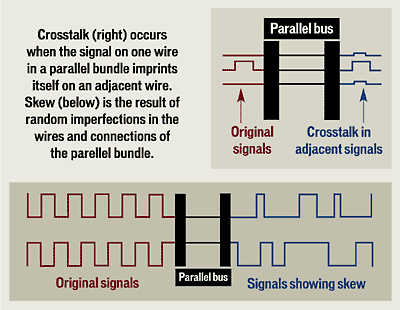
In the second parallel interface, the data is sent in the correct order, but some bits were received faster than others. Example of Parallel Transmission – Data Received Incorrectly Advantages and Disadvantages of Using Parallel Data Transmission The main advantages of parallel transmission over serial transmission are:. it is easier to program;. and data is sent faster. Although parallel transmission can transfer data faster, it requires more transmission channels than serial transmission. This means that data bits can be out of sync, depending on transfer distance and how fast each bit loads.
A simple of example of where this can be seen is with a voice over IP (VOIP) call when distortion or interference is noticeable. It can also be seen when there is skipping or interference on a video stream. When is parallel transmission used to send data?
Serial And Parallel Data Transmission Pdf
Parallel transmission is used when:. a large amount of data is being sent;. the data being sent is time-sensitive;. and the data needs to be sent quickly. A scenario where parallel transmission is used to send data is video streaming. When a video is streamed to a viewer, bits need to be received quickly to prevent a video pausing or buffering.
Video streaming also requires the transmission of large volumes of data. The data being sent is also time-sensitive as slow data streams result in poor viewer experience. QUANTIL provides acceleration solutions for high-speed data transmission, and, including mobile websites. If you want to know more about how we deliver data, you can tweet your questions to our team.
Definition Of Serial Transmission In Serial Transmission, data is sent bit by bit from one computer to another in bi-direction. Each bit has its clock pulse rate.
Eight bits are transferred at a time having a start and stop bit (usually known as a Parity bit) i.e. 0 and 1 respectively. For transmitting data to a longer distance, data cables are used.
It consists of D-shaped 9 pin cable that connects the data in series. Serial Transmission has two subclasses synchronous and asynchronous. In asynchronous transmission, an extra bit is added to each byte so that the receiver is alert about the arrival of new data. Usually, 0 is a start bit, and 1 is the stop bit.
In synchronous transmission, no extra bit is added rather the data transferred in the form of frames which contains multiple bytes. Definition Of Parallel Transmission In Parallel Transmission, various bits are sent together simultaneously with a single clock pulse.
It is a fast way to transmit as it uses many input/output lines for transferring the data. Parallel Transmission uses a 25 pin port having 17 signal lines and 8 ground lines. The 17 signal lines are further divided as. 4 lines that initiates handshaking,.
5 status lines used to communicate and notify errors and. 8 to transfer data.
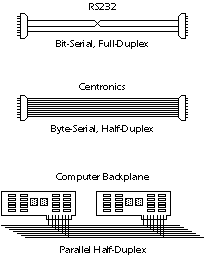
Key Differences Between Serial And Parallel Transmission. Serial transmission requires a single line to communicate and transfer data whereas, parallel transmission requires multiple lines.
Advantages Of Serial Data Transmission

Serial Transmission Vs Parallel Transmission
Serial transmission used for long distance communication whereas, the parallel transmission used for shorter distance. Error and noise are least in serial as compared to parallel transmission. Since one bit follows another in Serial Transmission whereas, in Parallel Transmission multiple bits are sent together. Parallel transmission is faster as the data is transmitted using multiples lines whereas, in Serial transmission data flows through a single wire. Serial Transmission is full duplex as the sender can send as well as receive the data whereas, Parallel Transmission is half duplex since the data is either sent or received.
Serial transmission cables are thinner, longer and economical in comparison with the Parallel Transmission cables. Serial Transmission is reliable and straightforward whereas, Parallel Transmission is unreliable and complicated.
Conclusion Both Serial and Parallel Transmission have their advantages and disadvantages respectively. Parallel Transmission is used for shorter distance, provides greater speed.
On the other hand, Serial Transmission is reliable for transferring data to longer distance. Hence, we conclude that both serial and parallel are individually essential for transferring data.